

STORY
From the encounter with the superb wines of Piedmont, northern Italy, a young man from Tokyo started his learning journey to become a Viticoltore*.
A couple of decades later, now fully involved in the wine industry here in the Barolo area, after many trials and errors, he finally developed wines that represent the perfect harmony between the Japanese concept of umami and the extraordinary power of yeasts native to this environment.
*Viticoltore is the Italian for viticulturist. However, this figure is much more than a vine grower, as the term often designates enologists and winemakers too. Here we keep the Italian word to fully embody our philosophy.
PHILOSOPHY
A Viticoltore knows the wind direction, the angle of the sunbeams, and how water drains off the soil, living together with the vineyards. They are at the same time a specialist viticulturist and wine producer. We call the wine brought on by this deep understanding and knowledge of the uniqueness of each vineyard and grape variety the Viticoltore's wine.
At Azienda Agricola TES the entire process, from soil preparation, to wine-growing and finally winemaking, is carried out by a single person. Only through this total dedication can we achieve the ultimate Viticoltore's wine.
CONCEPT
The yeasts present in the soil, leaves, and grass, naturally adhere to the grapes, transported by wind and rain. These yeasts constitute the core of the vineyard characteristics, directly affecting the personality of the grapes and shaping the structure of the wines they yield.
At Azienda Agricola TES, we believe it is possible to savor both the complexity of the yeasts of a fertile soil and its wine. We manufacture our pied-de-cuve with indigenous yeasts using only grapes from the same wine-yielding vineyards. Our vinification process reflects unique cultivation methods aimed at maximizing the yeast central role and integrating the Japanese concept of umami.
The accumulation of expertly calibrated, minimal interventions allows the full manifestation of the grape's potential and a clear expression of the terroir of the soil. This is the source of the uniqueness of TES’wines.
1
Between spring and summer, besides weeding, the fields are plowed without the use of machinery, to prepare the soil and create the perfect environment for the yeasts to adhere to the grapes.

2
The amount of grass and humidity levels are carefully regulated to ensure the thriving of yeasts and other microorganisms.
3
The smaller the grapes, the more yeasts adhere to their skin. For this reason, thinning is not done by clusters but based on the size of individual grape, to increase the concentration of umami components between the skin and pulp of the grapes.
The smaller the grapes, the more yeasts adhere to their skin.
For this reason, thinning is not done by clusters but based on the size of individual grape,
to increase the concentration of umami components between the skin and pulp of the grapes.
4
Vines are not pruned but twisted by hand. Besides avoiding the risk of disease the open cuts would represent, the leaves left on the plant, through photosynthesis, provide maximum nutrition, essential for umami.

5
We make our own pied-de-cuve using hand-picked grapes collected at the perfect timing before harvest.
6
We harvest each plant based on the ripeness of every individual cluster, rather than harvesting by plot or row.
We harvest each plant based on the ripeness of every individual cluster,
rather than harvesting by plot or row.
7
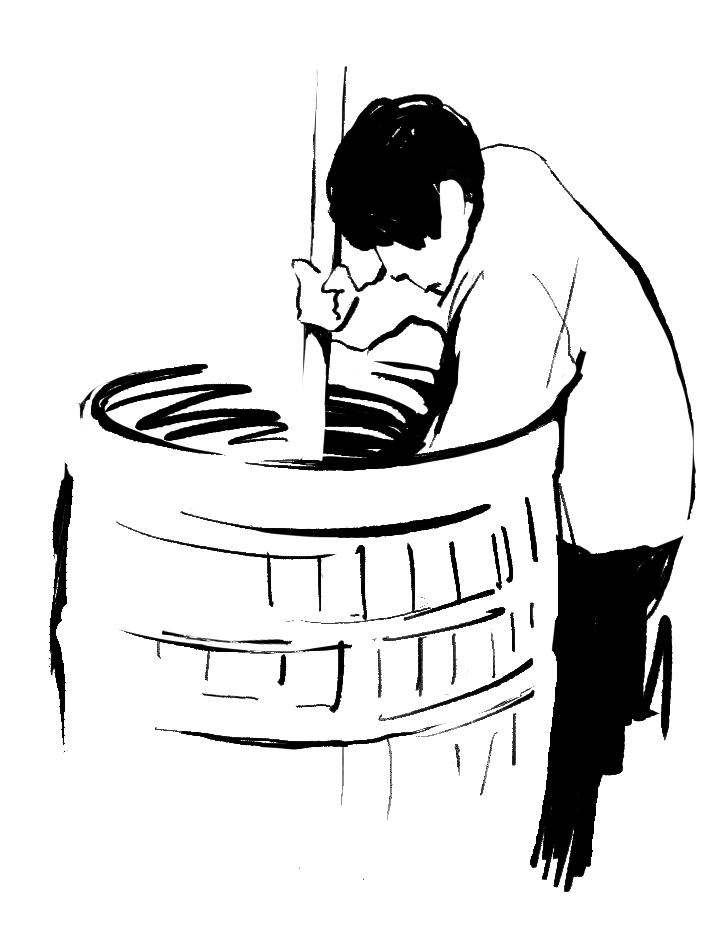
To stimulate yeast fermentation and the formation of umami components, we begin the brewing process by stirring grapes with paddles within 24 hours of harvest.
To stimulate yeast fermentation and the formation of umami components,
we begin the brewing process by stirring grapes with paddles within 24 hours from harvest.
8
From when the new sprouts appear, over a span of about two weeks, the caterpillars that feed off them are removed by hand, one by one, and when they are most active, at night.

9
To avoid nitrogen overload and contamination in case of vine disease, dry vine branches are not mixed into the soil.
VINO
Care in every detail
Which vine to leave, what leaf to cut, what grape to choose: every decision is carefully weighted as part of a full process where everything, from cultivation to vinification and bottling, is done by a single person, a rare sight in today’s winemaking scene. Here lies the secret to the flavors of our wines, brought out by the dedicated efforts our small-batch production allows.
TES
Barolo is obtained by the vinification of the Nebbiolo grape variety. Only grapes from designated vineyards can be used in the production. Furthermore, the wine must age at least 38 months before its release. TES combines the superior tannins and elegant acidic notes typical of Barolo, with the depth of umami and the freshness brought on by the yeasts.


VITICOLTORE
Charming patchwork-like vineyards. Open sky.
A land spotted with old houses passed down from one generation to the next.
Inspired by the simple yet welcoming local culture, and proud of its winemaking roots, I made the life-changing decision to become a Viticoltore myself.
I believe my mission is to translate the ancient philosophy of local, traditional winemaking into my wines, and to pass it on to future generations.
Tesu CYO
Born in Tokyo. He graduated in 2009 from Istituto di Istruzione Superiore "Umberto I" (State Institute of Higher Education “Umberto I”, also known as “Wine Institute”, a 6-year course) as the first pupil from Japan. In the same year, he started working for a leading winery in the area.
In 2017 he established his own winery, Azienda Agricola TES, releasing his first wine in 2021, TES BAROLO 2017. He further expanded the line-up with the release, in 2022, of TRE LANGHE NEBBIOLO, and the single vineyard TES BETTOLA vecchie viti 2019, in 2023.
Born in Tokyo. He graduated in 2009 from Istituto di Istruzione Superiore "Umberto I" (State Institute of Higher Education “Umberto I”, also known as “Wine Institute”, a 6-year course) as the first pupil from Japan. In the same year, he started working for a leading winery in the area. In 2017 he established his own winery, Azienda Agricola TES, releasing his first wine in 2021, TES BAROLO 2017. He further expanded the line-up with the release, in 2022, of TRE LANGHE NEBBIOLO, and the single vineyard TES BETTOLA vecchie viti 2019, in 2023.
